The Havenga Family
Websites by Family Members:
Menu
Memoirs of a Delville Wood Veteran
MY EXPERIENCES WITH THE SOUTH AFRICAN BRIGADE DURING WORLD WAR I
Extra! - Bernafay Wood & Delville Wood
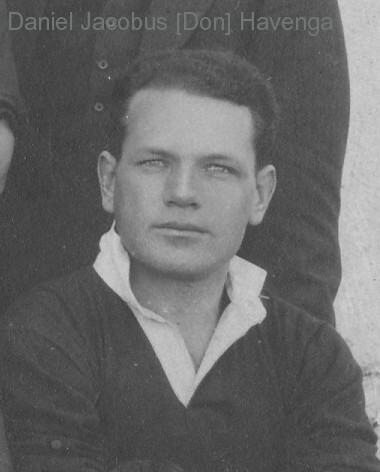
Transcribed from Daniël’s own handwritten notes, the chilling tale of hand to hand combat, heroic bravery and supreme sacrifices made by the Men of the South African Brigade.
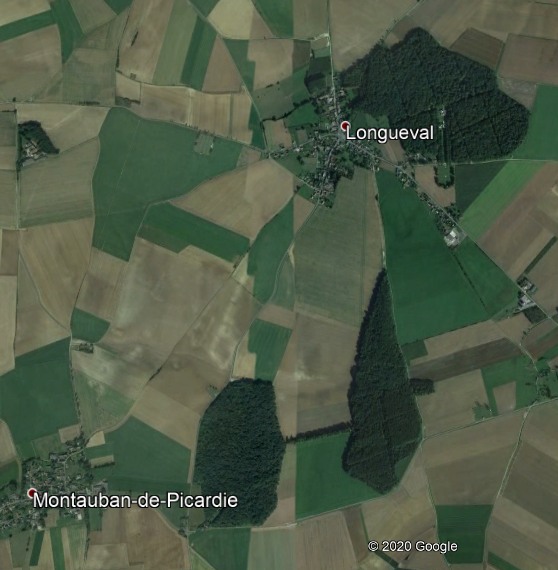
Bernafay Wood at the bottom left of the map. Image from Google Earth.
His exact account...
Bernafay Wood & Delville Wood
On 9th July the 2nd Regiment D Company were detailed to hold a section of the line in Bernafay Wood. Although we were there only about a week, our Company had lost about 50 casualties including Captain Clifford etc, mostly by shell fire.
On the 14th July we had to go over the top from Bernafay Wood with Delville Wood and Longeval as our objectives, perhaps the most difficult terrain of the front at that time for the ground sloped upwards from Bernafay which also formed a salient. Our attack was therefore under fire from three sides, which seriously hampered our communication. The work parties could not bring up any supplies, ammunition etc during the day, nor could the wounded be evacuated because they were constantly under fire.
It was no use taking Longeval unless Delville was also taken for all the roads were commanded by the wood which was still in German hands but had been heavily shelled by our artillery and was now a mess of splintered tree trunks and shell holes; the Germans had strong prepared entrenchments manned by machine guns.
We moved off before dawn on the 15th. By 6am we had reached a long ride afterwards called Princes Street which ran from Longeval right through to the perimeter of Delville Wood. By 3pm we had conquered Delville except a part of Longeval which was a strongpoint.
It was difficult and costly to have taken Delville Wood but much more difficult to hold out. It was now requested that we should only thin out and leave small infantry detachments with machine and Lewis guns. The troops who could be so spared to take the portion of Longeval still holding out but this was impossible as there was only about 20% of the troops left and the Germans were repeatedly counterattacking and held back with practically only rifle fire and they were attacking from prepared positions whereas we were exhausted and in unprepared positions mostly only the shell holes.
On the night of the 15th we were working for dear life at the entrenchments endeavouring to connect the various shell holes and bits of trenches for cover and movement. All this time the enemy shellfire was terrific and getting worse. No supplies or spades could be brought up to us and we had to dig with small trench tools which were like teaspoons against the churned up earth, roots of the trees and bodies and tree trunks lying everywhere.
All that Sunday we tried to strengthen the entrenchments under cover for at the slightest carelessness, the German snipers blazed away at the men. Moreover, the Brigade had to resist counter attack after counter attack. One was so exhausted it was difficult to keep awake.
That night we were instructed to retire to an imaginary street called Princes Street about the middle of Delville and the troops also to come out of Longeval so that the portions evacuated can be heavily bombarded by our artiliary and again attacked by us on the Monday morning. This attack was made shortly before dawn on the 17th but only those men like cats with nine lives survived. We were forced to fall back to our original positions, our casualties were very severe. Unfortunately the dead and severely wounded just had to be left behind.
At this time we witnessed one of the bravest deeds that could ever have been seen. No VC could ever have been more deserved but no destinction ever recorded. Lt Garnet Green wanted some Mills bombs. He was going alone to attack a machine gunner at the fatal enclosure which had just been nullified by the attack we just launched. Sgt Liebbrandt said he would join him. The two of them went over the top running from shellhole to shellhole, the Germans sniping at them all the time. Our section endeavoured to cover them and whenever a movement was seen at the German parapets there were bursts of rifle fire from the men. Several Germans were seen throwing up their arms and falling out of action, probably killed. Lt Green reached the enclosure, throwing several Mills bombs in the trench, the balance down the German dugout and returned wounded but would not go to the dressing station.
The cheers he received from the men gladdens my heart even to this day. Green’s bravery enabled the 3rd Regiment who were in support of the 2nd to successfully attack the redoubt.
That night the Germans attacked furiously and drove us out of our new trenches.
The next morning they continued to attack in the daytime. They were easy prey to our marksmen who took heavy toll of them.
That night came welcome news that we were to be relieved but this was a slow business only on the 20th Col. Thackery, who was then in charge, with two officers both wounded but still on their feet and some 120 other ranks of the brigade out of nearly 4000 men who originally entered Delville Wood and endured 5 days and 6 nights of undescribable Hell, marched out to Happy Valley where we were reviewed by Generl Lukin who had his cap in his hand and could only say “My men….. My men…….” before he broke down.
- Capt. HE Clifford and Capt. WJ Gray were listed as killed in action on 15 July 1916, having been observed as such by Hugh Mallet, a member of C Company, 2Bn SAI, while on his way to the dressing station with a fellow casualty.
- Lt. Garnet Green was awarded the Military Cross for his action and although wounded, was the last man out of Delville Wood when the South Africans were finally relieved on 20 July 1916. He later recieved a Bar to his Military Cross in 1917 for services at the Battle Of Arras and would later be promoted to Captain but was killed in action in March 1918.
- Sgt JS Liebrandt is listed as Missing In Action at Marrières Wood on 24 March 1918.
- Hugh Mallet was promoted to Sergeant in March 1918 and awarded the Distinguished Conduct Medal (DCM) on 3 October 1918. He was killed in action five days later, during the advance on Le Cateau.
Copyright © 1965 - 2026 The Havenga Family | All Rights Reserved
Unauthorized use and/or duplication of this material without express and written permission from this site’s author and/or owners is strictly prohibited.
Website by:
The Havenga Family