“I enjoyed it then. The designs, the interpersonal contact and negotiations, the freedom to roam the roads, the freedom to be my own boss. It was a challenge to find a solution to the many problems but I’m glad that I got out. It became too hectic.”
MSAIM, MCIT, MITSA, AMIRTE, MSAARET, N Dip Dr, N Dip Eng, SAIM Ad Dip Man, RAU Dip RT.
Notes In General
I’ve long since forgotten the detail of the load – where/when/origin and destination…
In studying the picture where it was loaded, I can recall loading in Durban harbour but nothing of the rest of the story comes back to me. I handled thousands of loads, worked long hours and took work home. Should I remember everything?
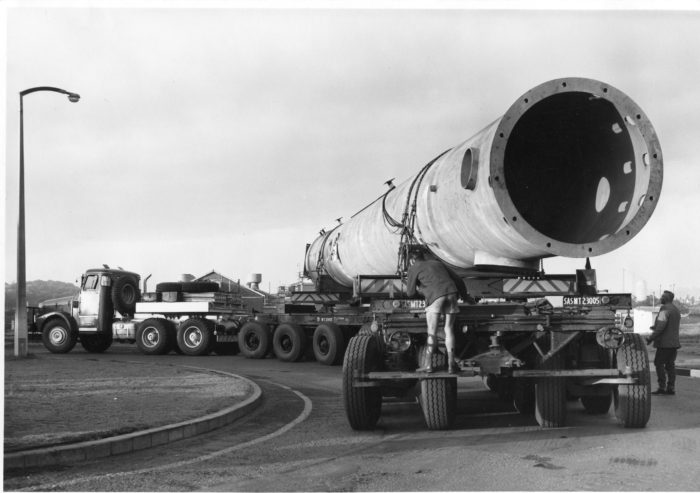
120t Transformer on a 6 Axle Hydraulic Trailer
120t Transformer on a 6 Axle Hydraulic Trailer
“It Kills Germs”
Quite an eccentric character, Inspector Schanknecht loved to suck the tobacco juice from anyones pipe stem, he said it “killed germs”
Here I stand watching as inspector Schanknecht , Shanks to us, pushes the transformer into position before it is lowered by the ships gantry. Quite an eccentric character, he loved to suck the tobacco juice from anyones pipe stem, he said it “killed germs”
He originated from East London where his father was reputed to be the executioner at the Lock Street gaol. His wife was a medical doctor and they moved in high circles but he was happy as a RTS Inspector.
When in town he got up early every morning to visit the racing stables, especially the Oppenheimers horses. His wife was friends with the Oppenheimers and he recounted many stories of life in the fast lane, as incongruous as it may seem.
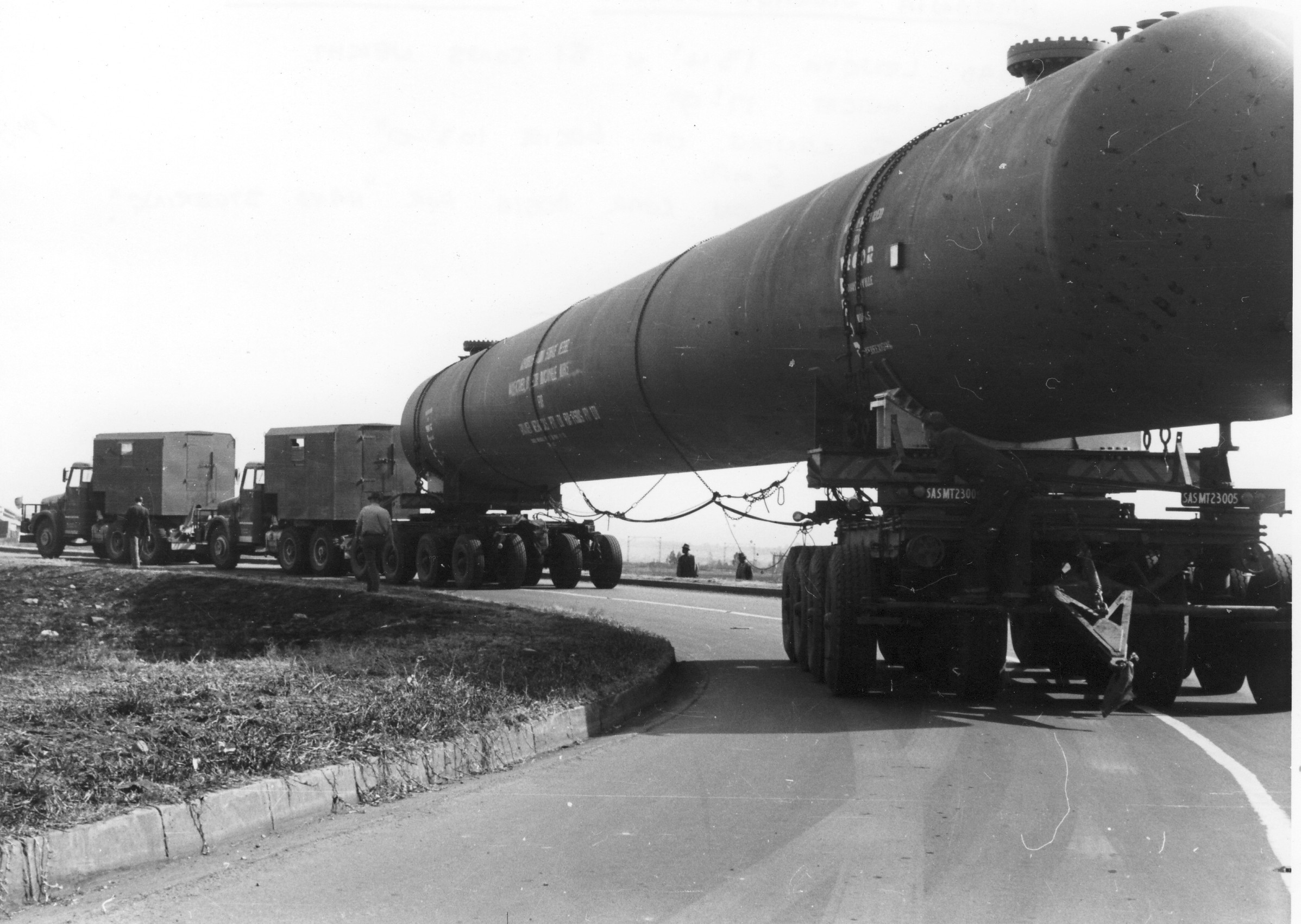
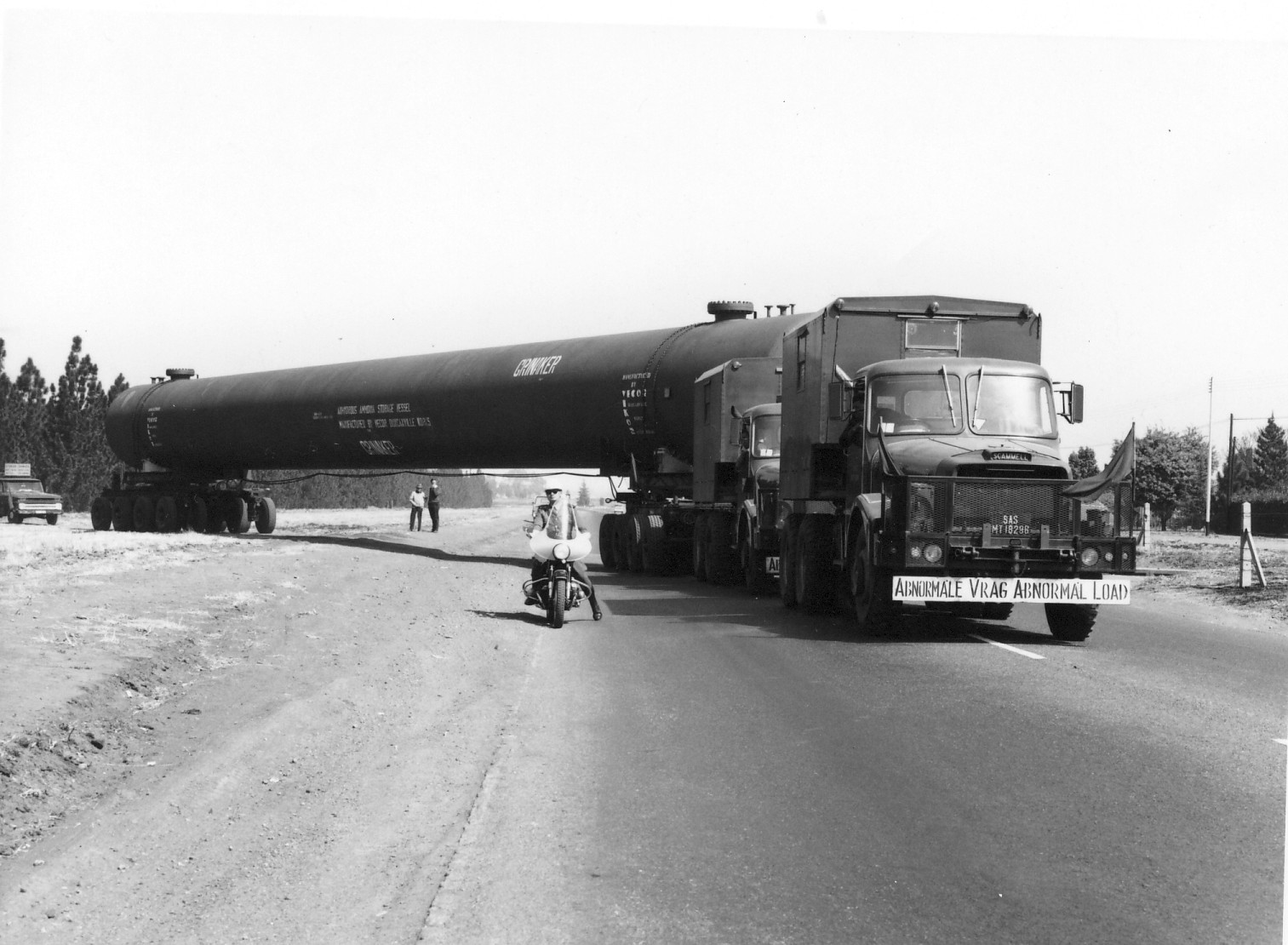
Another Amonia storage vessel on the way to Umbogintwini from Vecor. Taking up the whole road and causing major traffic problems in the process. Note the inspector – yes, Inspector Shanknect, walking at the rear. Some of these inspectors wore out a pair of shoes when walking halfway to durban on duty with the loads.
I pioneered this method of conveying pressure vessels, until then it had never been done before
Amonia Storage vessel enroute to Umbgintwini
“On one trip to Durban with a load like this, an old lady got such a fright when confronted with the load that she drove right into it. When they got to her, she had passed away.
The court decided that she had died of a heart attack and that nobody was to blame.”
"Hand Steerting"
Another view of the Ammonia storage vessel negotiating a traffic circle. Note the driver at the rear who is “hand steering” the rear bogie.
Previously all this type of pressure vessel had to be transported in small pieces and had to be welded together on site. This was probelmatical due to the stress relieving and X-rays of the welded seams.
Leaving Vecor, how well do I know this gate...
To my mind, the vessels were strong enough to be the chassis of the trailer. I made a proposal to the manufacturers to try my idea and they liked it. We spoke to the traffic authorities and we were in business!
117t Convertor
On the left is a Convertor of 117 tons (106 metric tonnes) This time you can clearly see the driver “hand steering” the bogie.
Circa 1965 – The first Oshkosh 3-axled abnormal load vehicle at Kaserne after acceptance from Huge Templeton of Barlows.
With me is Fred Hartley who was the Workshop Manager.
Oshkosh at Kaserne - 1965 - with Fred Hartley
This is a Fuel Distillation Cracking Tower leaving Vanderbijlpark.
I wrote the specification for this equipment bought from Henreds. It was made by Commeto in Italy and was more spophisticated than the older equipment and even had a seat for the driver at the rear to “hand steer” in comfort. The seat was my influence!
Each Bogie has 48 wheels x2 – 96 wheels in total. Imagine checking each one of them before moving off!!!
2 bogies with 48 wheels each, imagine checking them all before moving off!
Hunslet Taylor Shunting Loco
Hunslet Taylor Shunting Loco
Driving private locos over SAR&H track is fraught with dificulty as private drivers were not permitter on SAR&H track and SAR&H drivers were not permitted to drive private locos. To tow a loco is too costly as no other traffic is allowed to be hauled with the towed loco.
We helped out by taking the locos up by road from the Hunslet Taylor workshop in Germiston to Rhodesia (Zimbabwe) by road. We delivered about 5 of them for use on the mines They each weighed 54 tons (50 metric tonnes)
Still interested? See part two - "Riding the Rings" for the next set of photographs